The Problem Is Never One Tool
A user on Polycam's forum wrote something that stuck with me.
He'd scanned an existing building using Polycam's app. Beautiful, high-fidelity 3D capture, done in minutes on his phone. The technology worked exactly as promised.
Then he tried to get that scan into SketchUp.
After an hour of fighting with file formats, export settings, and conversion tools, he gave up. He exported the scan as a 2D DWG file and traced over it manually.
A 3D scan of an actual building, reduced to a flat drawing, because the workflow between tools was so broken that a professional gave up and reverted to a method from the 1990s.
That's not a technology problem. That's a space-between-tools problem.
How We Got Involved
Polycam had done something remarkable. They'd taken reality capture — technology that used to require $50K laser scanners and a week of processing — and put it on a phone. Architects, contractors, facility managers, anyone could scan a building in minutes and get a usable 3D model.
Adoption was growing fast. The AEC industry was excited. But Polycam's team kept hearing the same feedback from their professional users:
"The scan is great. What do I do with it now?"
The scan lived in Polycam. The design work happened in SketchUp, Revit, Rhino. The presentation happened in PowerPoint or InDesign. Every handoff between tools required format conversion, quality loss, and a level of technical knowledge that most design professionals didn't have and shouldn't need.
The workflow looked like this: Scan in Polycam → export to .PLY or .OBJ → convert in a third-party tool → import to SketchUp → spend an hour cleaning up what the conversion broke → get frustrated → wonder if you should have just measured by hand.
Polycam asked us to consult on strategy. How do we close this gap? Where's the highest-impact integration point?
Why SketchUp
The answer wasn't complicated, but it required looking at the market instead of the technology.
SketchUp has the largest install base in AEC. It's the tool that small firms, solo practitioners, and contractors actually use every day. It's accessible, fast, and ubiquitous. If you wanted to reach the broadest possible audience of AEC professionals who were already scanning with Polycam, SketchUp was the obvious target.
But the real insight was about what users needed, not what engineers wanted to build.
Engineers wanted to push the highest-fidelity data through the most advanced pipeline. Users wanted to scan a room and start designing in the tool they already know. Those are different goals. We chose the user's goal.
Seamless workflow from Polycam's 3D scanning directly into SketchUp — Watch Video
What We Built
A custom SketchUp Extension that connected Polycam's scanning directly to SketchUp's modeling environment. No intermediate conversion. No third-party tools. No hour of fighting with file formats.
Scan with Polycam. Open SketchUp. Click import. Done.
The workflow that used to take an hour — or caused people to give up entirely — took minutes.
We timed the launch to the 2025 AIA Conference in Boston. Five thousand downloads in the first week.
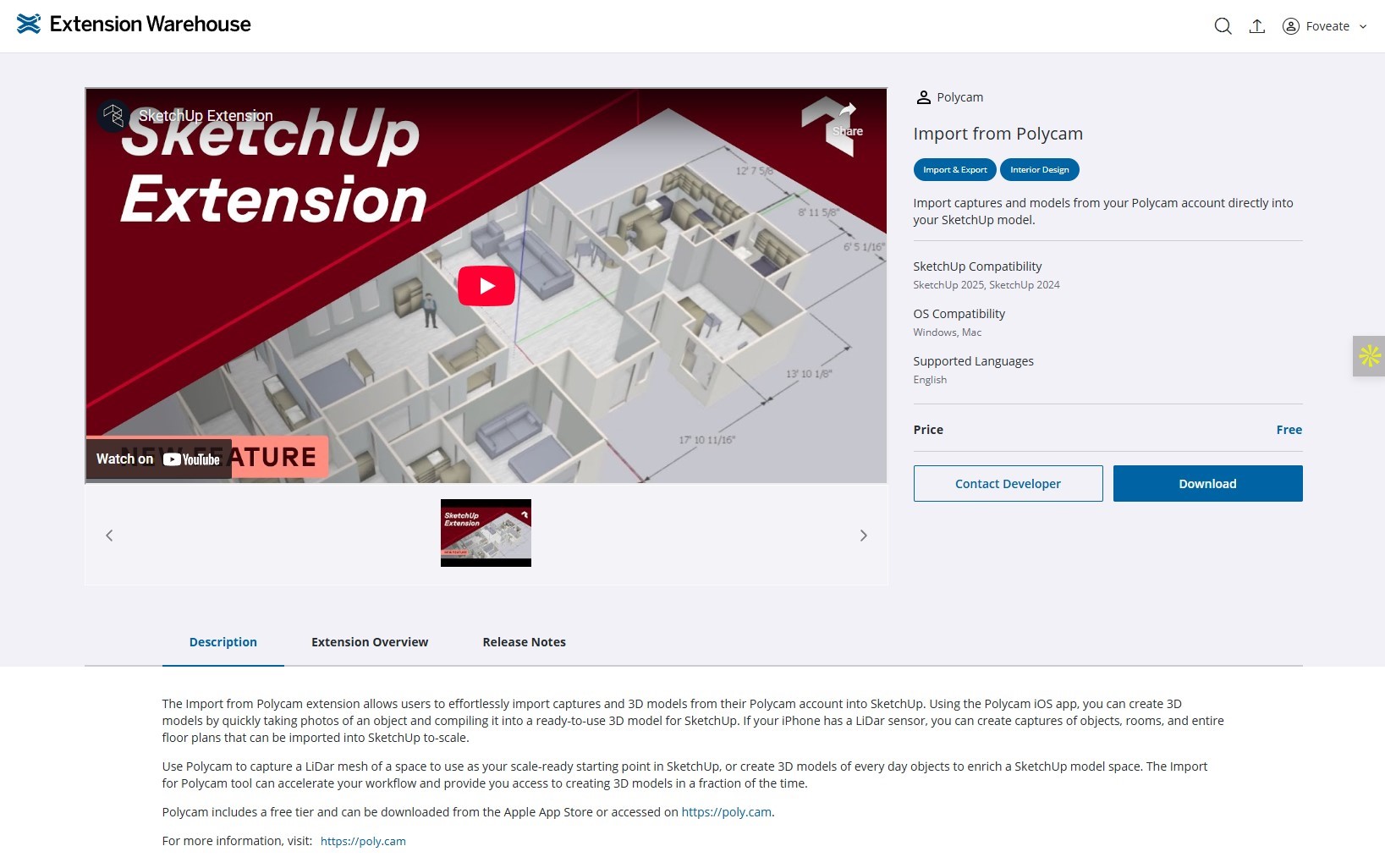 The Polycam SketchUp Extension received over 5,000 downloads its first week
What This Taught Us About Foveate
Here's the thing that changed how I thought about what we were building.
Polycam's technology was excellent. SketchUp's technology was excellent. The problem wasn't that either tool was bad. The problem was the space between them.
Every AEC professional I know uses 6 to 12 tools in a typical project. Rhino for modeling. SketchUp for concepting. Revit for documentation. Photoshop for rendering. InDesign for proposals. Excel for budgets. PowerPoint for presentations. Google Drive for file sharing. Email for everything else.
Each tool is fine on its own. But the workflow between them — the exports, the conversions, the reformatting, the version control, the "which file is the latest?" chaos — that's where value dies. That's where an architect's 3D scan becomes a 2D DWG. Where a beautiful render becomes a JPEG in a PDF. Where a design team's conviction becomes bullet points on slide 14.
The problem is never one tool. It's the space between tools.
That insight shaped Foveate's entire architecture.
We didn't build another tool that requires exporting into something else. We built a platform where 3D models, video, documents, client data, engagement analytics, and presentation design all live in the same place. One source of truth. One link. One experience. No handoffs. No format conversion. No fidelity loss.
Because every time you move work from one tool to another, you lose something. Sometimes it's resolution. Sometimes it's context. Sometimes it's the story itself.
The firms that win don't just have better tools. They have fewer gaps between their tools.
The Lesson for Design Firms
I tell this story to architects and designers because most of them are living in the space-between-tools right now without realizing it.
Your team designs in Rhino. Someone exports a screenshot. Someone else pastes it into InDesign. Someone formats it into a 47-page PDF. Someone emails it. The client opens it on their phone, pinch-zooms, gives up, puts it down. Your 3D design — the spatial, immersive, experiential thing you spent months building — has been converted into a flat image on a flat page on a flat screen.
Each conversion lost something. By the time the client sees it, they're not experiencing your design. They're reading a document about your design.
That's the same problem Polycam's user had. The technology was there. The fidelity was there. The workflow destroyed it.
Your proposals are the same. The work is extraordinary. The format between you and the client is where it dies.
Stop converting. Start presenting.
That's what Foveate does — one link, one source of truth, every format your client needs. If your best work keeps getting lost in translation between tools, we should talk.
About the Author
Kitae Kim
Architect with 10 years of experience in design and client communication. Co-founder of Foveate, the Pursuit Intelligence Platform for AEC firms. Former studio lead who saw too many winning designs lose to worse proposals.
More from firms using Foveate
Case Study
The 'Difficult Client' Who Wasn't Difficult
The client kept changing direction. The firm was losing money on rework. Everyone assumed the client was the problem. They weren't. Nobody had taken the time to understand what they actually wanted — because the profession doesn't have tools for that.
Case Study
The Innovation Was Invisible
Peter Arbour invented a building technology that could change how cities look and perform. Investors kept passing. Not because the technology wasn't real — because the pitch materials couldn't make them feel it.
Interview
How Immersive Architecture Presentations Are Winning More Clients
On the EntreArchitect Podcast, Kitae Kim shares why connection, not just concepts, wins projects, and how immersive storytelling with Foveate helps designers communicate value, build trust, and close with confidence.
This article is part of our guide to firms putting this into practice.
Explore Portfolio Intelligence