The "Difficult Client" Who Wasn't Difficult
Ramona called me frustrated.
She's a friend, a collaborator, and one of the best residential architects I know. Her firm — Ramona Albert Architecture — has a reputation for client-centered design. They listen. They care. They do the work.
But one client was breaking them.
Inconsistent feedback. Contradictory direction. The client would approve a design approach in one meeting and reject it in the next. Scope kept shifting. Rework was eating the budget. The team was demoralized. Three redesigns deep, nobody knew what the client actually wanted — including, it seemed, the client.
Ramona's instinct — the instinct every architect has in this situation — was to assume the client was the problem. Indecisive. Unreasonable. The kind of engagement you survive, not enjoy.
I asked her a different question.
"What do you actually know about this person?"
The Intelligence Gap
Ramona knew the client's name, their budget, and the site. She knew the square footage they wanted and the number of bedrooms. She had notes from a dozen meetings.
But she didn't know what I needed her to know.
She didn't know the client's actual values — not the ones they stated in the first meeting, but the ones driving their decisions three months later. She didn't know their aesthetic language — the specific visual vocabulary that meant "yes" to them versus the one that meant "interesting but not for me." She didn't know their decision-making pattern — whether they processed visually or verbally, whether they needed time to sit with an idea or responded best to bold first impressions.
She had twelve meetings of data. She had zero intelligence.
That's not a criticism of Ramona. It's a description of the entire profession.
Architecture firms invest months understanding the people who will use a building. They study circulation patterns, sight lines, acoustic environments, material psychology. They obsess over how a stranger will experience a threshold or a staircase.
Then they walk into a client meeting having done zero research on the actual human who will decide whether the project lives or dies.
We study buildings. We don't study clients.
And we wonder why the relationships feel hard.
What We Actually Did
I told Ramona we'd profile the client. Not a personality test. Not a survey. A deep-dive research process that drew on methods I'd learned from years in experiential design, luxury hospitality, and fine art — industries where understanding the psychology of the person across the table isn't optional, it's the entire business model.
We started with what we had: the twelve meetings of notes, the approved and rejected design directions, the emails, the mood boards they'd responded to and the ones they hadn't.
Then we looked at what nobody had thought to look at.
Their public presence — interviews, social media, projects they'd funded before, causes they supported, spaces they'd chosen to spend time in. Not to be invasive. To understand who they are in the way a luxury hotel understands a returning guest — so that every interaction feels considered, not generic.
The pattern that emerged was clear. And it explained everything.
What We Found
The client wasn't indecisive. They were misunderstood.
The "inconsistent feedback" had a pattern. Every time the design leaned toward a certain minimalist vocabulary — clean lines, white walls, restrained palette — the client approved. Every time it drifted toward something warmer, more textured, more organic, they pulled back. But they couldn't articulate why, because they didn't have the design language to say "I want authenticity, not warmth."
The word "natural" was the trap. The client kept saying they wanted "natural" materials. Ramona's team interpreted that as warm wood, raw stone, earthy textures. The client meant something completely different — they meant honest, unadorned, structurally expressive. "Natural" to them was exposed concrete, not reclaimed barn wood.
One word. Two completely different aesthetic visions. Three redesigns because nobody had profiled what the client actually meant when they used the words they used.
We also discovered something deeper. The client cared intensely about the local community. This wasn't just a house to them. It was a landmark — a project they wanted their neighborhood to be proud of. That value — community legacy — had never surfaced in any design meeting, because nobody had thought to ask about it. But it was driving every hesitation, every "let me think about it," every apparent change of direction.
They weren't being difficult. They were trying to protect something they didn't know how to express.
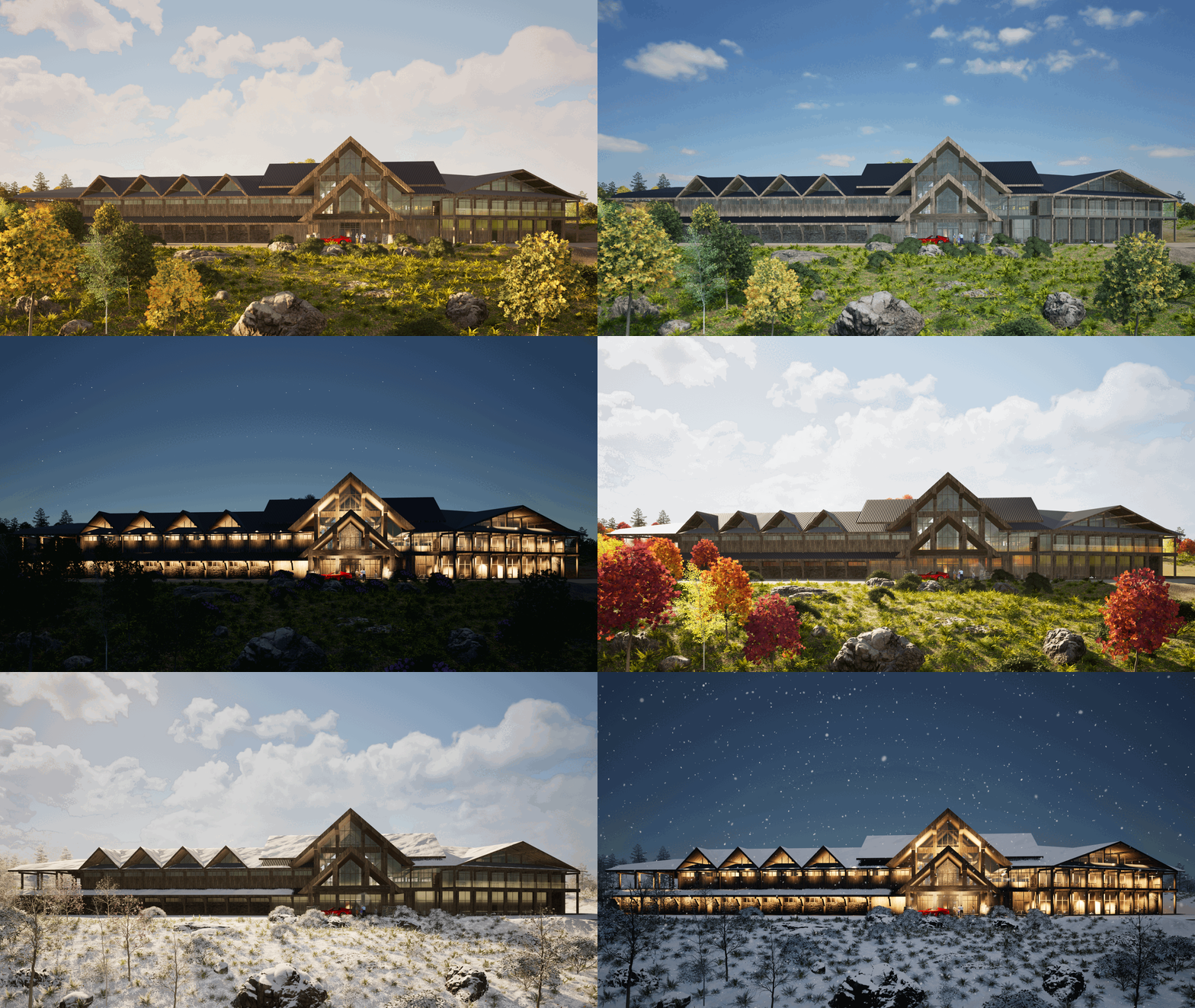 Timelapse of the project throughout different seasons — showcasing details that mattered to the client once we understood what they actually valued
What Changed
We presented the profile to Ramona's team. Not as a report — as a translation guide. Here's what the client means when they say "natural." Here's what they're protecting when they hesitate. Here's how to present options in a way that maps to their actual decision-making style.
The next meeting was different.
Ramona's team showed bold, structurally expressive renderings — colorful, confident, community-facing. Not the safe, warm palette they'd been defaulting to. The client lit up. For the first time in months, the conversation wasn't about fixing problems. It was about pushing further.
The rework stopped. The budget stabilized. The relationship transformed from transactional to collaborative. The client started referring other projects to the firm — something that never happens when a client feels misunderstood.

What It Taught Us
I've thought about this project more than almost any other, because it names the problem so precisely.
The architecture profession has a "difficult client" epidemic. Every firm has stories. The client who can't make up their mind. The client who keeps changing the brief. The client who approved something and then reversed course.
Most firms respond by working harder. More revisions. More meetings. More patience. More billable hours absorbed. They treat it as a character flaw in the client that must be endured.
But what if most "difficult clients" aren't difficult? What if they're just misunderstood?
What if the problem isn't that they keep changing their mind, but that nobody took the time to understand how their mind works?
That's the question that created Foveate's Client Profiler.

Intelligence Is Hospitality
There's a reason I keep coming back to the luxury hotel comparison.
A great hotel doesn't treat every guest the same. It profiles them. It remembers their preferences. It anticipates their needs. The guest doesn't think "they tracked my data." The guest thinks "they know me." And that feeling — of being truly known — is worth paying a significant premium for.
Clients are the same.
The client who feels understood doesn't nickel-and-dime your fee. They don't shop three other firms for a lower number. They don't second-guess your design direction in every meeting. They trust you — because every interaction signals that you took the time to understand who they are.
That trust is worth more than any rendering. More than any 3D model. More than any beautifully formatted PDF.
And it starts with intelligence. Knowing who you're designing for — not just their square footage and their budget, but their values, their aesthetic language, their decision-making patterns, the things they care about that they haven't told you yet because nobody thought to ask.
Ramona's client wasn't difficult. They were waiting for someone to understand them.
Most of your clients are too.
How This Became Client Profiler
The profiling process we did manually for Ramona — the research, the pattern analysis, the translation of stated preferences into actual values — is now built into Foveate.
Client Profiler uses AI-powered research to help you understand who you're presenting to before you open the first slide. It surfaces values, decision patterns, communication preferences, and organizational dynamics. It builds a living profile that deepens with every interaction — every form response, every proposal engagement, every section a client lingers on or skips.
Over time, you don't just know your clients. You understand them. And the experience of being understood by the people you've hired to shape your physical world is the rarest and most valuable thing in this profession.
It's the difference between the $300 hotel and the $1,500 hotel.
It's the difference between a vendor and a partner.
And it starts with asking the right questions about the person on the other side of the table — before you ever show them a design.
That's what Foveate is building. If you're tired of difficult clients who might just be misunderstood ones, we should talk.
About the Author

Kitae Kim
Architect with 10 years of experience in design and client communication. Co-founder of Foveate, the Pursuit Intelligence Platform for AEC firms. Former studio lead who saw too many winning designs lose to worse proposals.
More from firms using Foveate
Case Study
The Innovation Was Invisible
Peter Arbour invented a building technology that could change how cities look and perform. Investors kept passing. Not because the technology wasn't real — because the pitch materials couldn't make them feel it.
Case Study
The Problem Is Never One Tool
Polycam had democratized 3D scanning. But their users couldn't get scans into the tools they actually use without losing their minds. One user gave up and reverted to 2D DWG imports. That frustration — the space between tools — became the insight that shaped Foveate's platform architecture.
Interview
How Immersive Architecture Presentations Are Winning More Clients
On the EntreArchitect Podcast, Kitae Kim shares why connection, not just concepts, wins projects, and how immersive storytelling with Foveate helps designers communicate value, build trust, and close with confidence.
This article is part of our guide to firms putting this into practice.
Explore Portfolio Intelligence